

Vending Operators8 min read
On this page
The vending industry is a cornerstone of the American economy, contributing $7.9B in annual revenue, and provides millions of people with convenient access to snacks and beverages. As the industry evolves into the $31.1B unattended retail market, the expectations for transparency and professionalism have never been higher. For the dedicated operator, staying ahead of compliance isn’t just about avoiding fines; it is about building trust with every customer who taps their card at one of your machines.
At The Vending Club, we view our community as the industry hub for shared knowledge and operational excellence. One of the most common questions from our members involves the intricate web of FDA vending machine labeling rules. Whether you are a seasoned pro managing a large route or a new entrepreneur scaling your first few machines, understanding these requirements is essential for a sustainable business.
This guide breaks down the core federal requirements, specifically focusing on 21 CFR 101.8, to help you navigate the nuances of calorie disclosure and general food labeling.
Determining Your Compliance Threshold
The first step in any compliance journey is identifying if the specific federal rules apply to your operation. The FDA’s calorie labeling requirements for vending machines are primarily targeted at larger businesses to ensure consistency across the marketplace.
Under the current rules, the mandate applies to vending machine operators who own or operate 20 or more vending machines. If you fall into this category, you are legally required to provide calorie disclosures for “covered foods” — items where the nutrition information is not otherwise visible to the consumer before the point of purchase.
However, even if you manage fewer than 20 machines, you can choose to voluntarily register with the FDA to be covered by these regulations. Many growing operators choose this path to demonstrate their commitment to transparency or to align with the requirements of high-profile locations like healthcare facilities in Nebraska or government buildings. For those who are not covered and do not register, these specific federal calorie disclosure rules do not apply, though general food safety and labeling standards still remain in effect at the state and local level.
Calorie Disclosure Specifics and Placement
For covered operators, the core of the rule is ensuring that a customer knows exactly how many calories are in a product before they make a selection. This transparency is a key part of the modern healthy vending movement in Florida and beyond.
The calorie declaration must be clear, conspicuous, and placed in close proximity to the food item or its selection button. This means the information should be visible at the exact moment the consumer is deciding whether to purchase.
Numeric Value and Rounding Rules
The FDA is specific about how these numbers should appear. You cannot just guess or use approximate ranges. The numeric calorie value must be declared based on the article of food as it is sold.
- For items up to and including 50 calories, the value must be rounded to the nearest 5-calorie increment.
- For items above 50 calories, the value must be rounded to the nearest 10-calorie increment.
- If an item contains fewer than 5 calories, you may express the value as “0.”
Every declaration must also be accompanied by the term “Calories” or “Cal” immediately adjacent to the number. This ensures there is no confusion regarding what the numeric value represents.
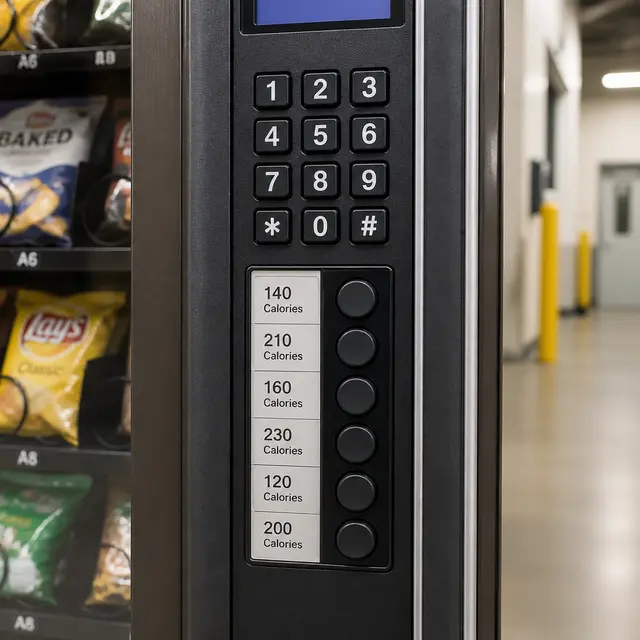
Calorie declarations placed directly beside the selection buttons keep the information visible at the moment of purchase.
Strategic Placement for Maximum Visibility
You have several options for how to display this information. You can use individual signs for each item, a single bulk sign listing all covered foods in the machine, or a combination of both. The key is that the sign must be “in, on, or adjacent to” the vending machine. If your machine uses digital displays, you can integrate the calorie information directly into the selection screen, provided it remains visible during the purchase process.
Navigating Glass-Front Machines and Front-of-Pack Labeling
Glass-front machines offer a unique advantage in the vending world — the product is the advertisement. Because the consumer can see the actual package, the FDA provides an alternative to separate signage: front-of-pack (FOP) calorie labeling.
If the nutrition facts or calorie information on the package itself is clearly visible through the glass at the point of purchase, you may not need additional signs on the machine. However, the FDA has established strict standards for what qualifies as “visible.”
For a front-of-pack calorie declaration to satisfy the rule in a glass-front machine, the type size of the calorie count must be at least 150% of the minimum required size of the net quantity of contents declaration. This ensures that even through a layer of glass and potentially varying light conditions, the consumer can easily read the caloric information.
This rule is particularly important for operators of micro markets in Florida or smart coolers, where the interaction with the product is more direct but compliance standards remain high. If the package is too small to bear such labeling, like small packs of gum or mints, and is sold in a glass-front machine, specific exemptions or alternative disclosure methods may apply.
General Labeling Requirements Under 21 CFR 101.8
While calorie counts get the most attention, they are only part of the broader regulatory framework. General food labeling per 21 CFR 101.8 requires that every article of food sold in a vending machine bears specific identifiers. Even if you are a new operator in South Carolina with only two machines, these general standards are good practice for maintaining a professional operation.
The three pillars of general labeling are:
- Name of the Food: A clear statement of what the product is (e.g., “Salted Almonds” or “Granola Bar”).
- Net Quantity of Contents: The weight, measure, or numerical count of the food in the package.
- Manufacturer and Distributor Information: The name and place of business of the manufacturer, packer, or distributor.
For most pre-packaged snacks from major suppliers, this information is already on the wrapper. However, if you are providing “house-made” items or unbranded bulk goods, you must ensure these details are provided. This is especially relevant for businesses exploring smart coolers in Georgia where fresh, local food is often a primary selling point.
Practical Compliance Tips for Vending Operators
Maintaining compliance across a large route can feel daunting, but a systematic approach makes it manageable. Here are several strategies to keep your operation in line without sacrificing efficiency.
Standardize Your Signage
Instead of creating custom labels for every machine, develop a standardized template for your calorie disclosure signs. Using a clear, sans-serif font with high contrast (such as black text on a white or yellow background) ensures legibility and meets FDA standards for “clear and conspicuous” display.
Perform Regular Compliance Audits
Include a labeling check as part of your routine machine servicing. When your drivers refill the machine, they should verify that all calorie signs are still attached and legible. If you use glass-front machines, they should ensure the products are faced correctly so the front-of-pack labels are visible.
Leverage Technology
Many modern vending management systems (VMS) allow you to track the nutritional data of your inventory. If you use digital touchscreens or smart machines, this data can often be pushed automatically to the consumer interface. This reduces the need for physical stickers and ensures that your calorie counts are always accurate, even when you swap out one granola bar for another.

A quick labeling check during every service visit keeps front-of-pack declarations visible and signage in place.
Collaborate with Your Suppliers
Your suppliers are your partners in compliance. When sourcing new products, prioritize those that already feature FOP calorie declarations that meet the 150% type-size requirement. This can significantly reduce the amount of extra signage you need to maintain on your machines. For those looking for new partners, checking trade organizations can help you find compliant-focused vendors.
Building a Professional Foundation
Compliance is more than a legal hurdle — it is a hallmark of a professional vending operation. By following the FDA vending machine labeling requirements, you position your business as a trusted provider in the eyes of both your location partners and your end-users. Keep in mind that labeling is only one layer of the compliance picture: our overview of vending machine regulations across all 50 states covers how licensing, permits, and health codes vary by market.
Whether you are scaling your route to reach the 20-machine threshold or simply looking to improve your service quality, being diligent about food labeling is a smart business move. As the industry continues to grow, those who prioritize transparency will be best positioned to capture a share of the expanding unattended retail market.
For more insights into growing your business and connecting with fellow industry leaders, explore our guide to the best vending communities.
Frequently Asked Questions
Does the calorie labeling rule apply if I only have five machines?
No, the federal calorie labeling mandate under 21 CFR 101.8 specifically applies to operators with 20 or more machines. However, smaller operators can choose to voluntarily register for the program.
Where exactly should I place the calorie information?
It must be “in close proximity” to the food item or the selection button. This means a customer should be able to see the calories at the same time they see the price or the name of the product.
Can I use a QR code instead of a physical sign for calories?
The current FDA rules require the calorie information to be visible “at the point of purchase” without the need for additional steps from the consumer. While QR codes can provide supplemental nutrition facts, they do not replace the requirement for a visible calorie count.
What is the rounding rule for items with 45 calories?
According to FDA guidelines, items up to 50 calories should be rounded to the nearest 5-calorie increment. Therefore, a 45-calorie item would be declared as “45 Calories.” An item with 153 calories would be rounded to “150 Calories.”
What happens if a product’s packaging blocks the calorie sign?
Compliance requires the information to be “clear and conspicuous.” If a sign is obscured, you are technically out of compliance. It is best to place signs on the machine frame or integrated into the selection display to avoid obstruction by shifting stock.
Are there different rules for drinks versus snacks?
The calorie labeling requirements apply to all “covered foods,” which includes both snacks and beverages sold in vending machines where the nutrition facts are not visible before purchase.
Do you have questions about how these rules apply to your specific machine types or location contracts? Connect with fellow operators through our vending community hub to hear how others are staying compliant.