

Vending Operators8 min read
On this page
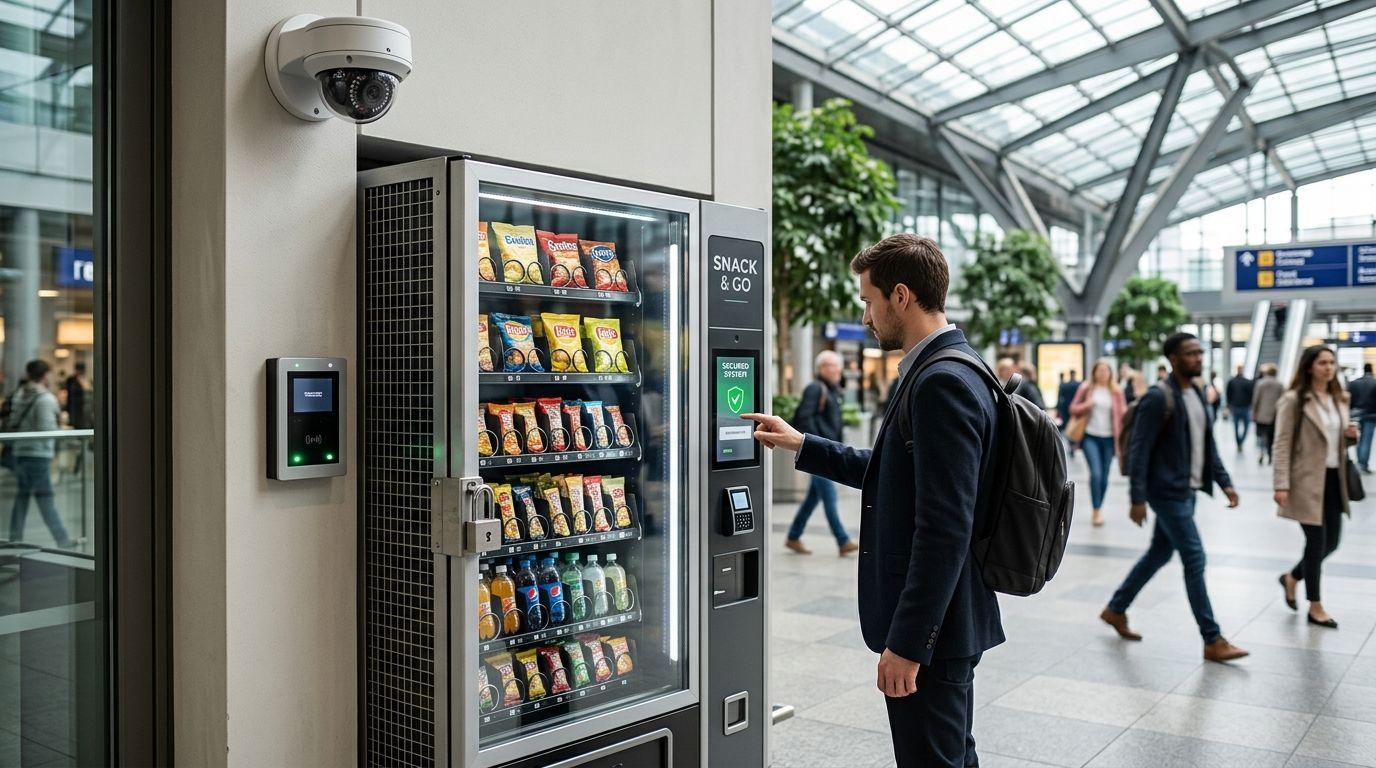
Vending machine security covers more than a lock on the cash box. Cash theft, product pilferage, vandalism, and forced-entry break-ins each show up differently depending on route type, machine location, and how much of your revenue still moves as cash, and the right combination of vending machine security systems for 2026 depends on which of those risks hits your route hardest.
TL;DR- Vending machine security systems in 2026 combine mechanical locks, telemetry alerts, cameras, and cashless payment to reduce theft exposure.
- No single layer stops every incident; most operators run two or three protection types per machine location.
- Telemetry and remote monitoring flag door-open and power-loss events in real time without replacing physical locks.
- Vending machine insurance stays a financial backstop even when other security layers are already in place.
- Location risk, retrofit complexity, and ongoing monitoring requirements matter more than any single feature when comparing systems.
Why this matters
A vending machine sitting in a low-traffic hallway or an outdoor location overnight is a different risk profile than one inside a staffed office break room. Operators building a security checklist for 2026 need to weigh where a machine sits, how much cash it holds between collections, and how quickly they'd know if something went wrong.
The categories below are neutral system types, not a ranked list of vendors. The Vending Club maintains operator tools and state guides that cover related decisions, including cashless payment setup and telemetry adoption, without recommending one provider over another.
What to evaluate before adding a security layer
Before comparing specific hardware or software, run each option against the same criteria:
- Risk addressed. Cash theft, product pilferage, vandalism, and full equipment break-ins call for different tools.
- Retrofit complexity. Some systems bolt onto existing machines; others require a machine swap or manufacturer-specific hardware.
- Monitoring requirement. A system that only logs data after the fact behaves differently than one that sends a real-time alert.
- Integration with existing telemetry or POS. Duplicate systems that don't talk to each other create blind spots.
- Documentation value for insurance. Some systems produce records an insurer will accept as proof of a loss event; others don't.
- Ongoing cost structure. Hardware-only purchases behave differently than subscription-based monitoring over a multi-year route.
At a glance: Vending machine security system types
| System type | Primary risk addressed | Typical setup | Key limitation |
|---|---|---|---|
| Mechanical and high-security locks | Forced entry, drilling, prying | One-time hardware swap | No alert if the machine is breached |
| Electronic locks and access control | Unauthorized or ex-employee access | Retrofit kit or new machine | Requires code or key-fob management |
| Telemetry and remote monitoring | Door-open events, power loss, tampering | Sensor plus data connection | Alerts, doesn't physically stop entry |
| Video surveillance | Vandalism, loitering, identifying suspects | Camera plus storage or cloud plan | Coverage limited to camera field of view |
| GPS and asset tracking | Full machine theft or relocation | Hidden tracker unit | Doesn't prevent removal, only locates it |
| Cashless payment | Cash-box theft specifically | Card reader integration | Doesn't reduce product pilferage |
| Vending machine insurance | Financial loss after any incident | Policy plus documentation | Reactive, not preventive |
1. Mechanical and high-security locks
Standard tubular locks that ship on many machines are a known weak point; upgrading to a high-security cam lock or a T-handle lock designed for vending cabinets raises the effort required to force entry. This is usually the first layer an operator adds because it requires no subscription and no data connection.
Mechanical lock pros:
- One-time hardware cost with no ongoing subscription
- Works on machines with no power or data connection nearby
- Simple for a route driver to service and re-key
Mechanical lock cons:
- Provides no alert when a breach happens
- Doesn't stop an experienced actor with the right tools
- Re-keying an entire route after a key is lost takes time
Works well for: machines in low-traffic or unattended locations where a real-time alert isn't yet in the budget. Priority: Essential baseline for nearly every route, regardless of what else gets added.
2. Electronic locks and access control
Electronic locks replace a physical key with a code, fob, or app-based credential, and many models log every open event with a timestamp and user ID. This matters most on routes with multiple route drivers or subcontractors, where an operator needs to know who opened which machine and when.
Electronic lock pros:
- Individual access credentials instead of one shared key
- Time-stamped open logs support accountability
- Credentials can be revoked instantly when staff turnover happens
Electronic lock cons:
- Battery or power dependency on some models
- Higher upfront hardware cost than a mechanical lock
- Credential management adds an administrative step
Works well for: operators running multiple route drivers or subcontracted service across a larger territory. Priority: Recommended once a route grows past a size where one person still holds every key.
3. Telemetry and remote monitoring alerts
Telemetry systems built for inventory and sales tracking increasingly include security-relevant alerts: Door-open events outside scheduled service windows, power interruptions, and repeated failed transactions. These systems don't stop a break-in physically, but they shorten the time between an incident and an operator finding out about it.
Telemetry pros:
- Real-time or near-real-time alerting on unusual events
- Often bundled with the same system already tracking sales and inventory
- Creates a timestamped record useful for insurance claims
Telemetry cons:
- Requires a data connection (cellular or Wi-Fi) at every location
- Ongoing subscription cost on top of hardware
- An alert only helps if someone acts on it quickly
Operators comparing telemetry and remote monitoring options for 2026 are weighing the same alert and connectivity trade-offs as they weigh sales-tracking features, since the two functions usually run on the same platform. The Vending Club covers how those systems differ on connectivity type and reporting.
Works well for: routes spread across multiple locations where a physical daily check isn't practical. Priority: Recommended for any route where machines sit more than a day between visits.
4. Video surveillance and camera systems
A camera pointed at a machine, whether owned by the operator or already installed by the location host, deters some vandalism and loitering and helps identify a suspect after an incident. Coverage depends entirely on camera placement and field of view, so a single camera rarely covers blind spots on the sides or rear of a machine.
Camera system pros:
- Visible deterrent effect at high-traffic or public locations
- Footage supports police reports and insurance claims
- Cloud-based storage options avoid on-site hardware failure
Camera system cons:
- Coverage gaps outside the camera's field of view
- Storage and monitoring costs add up across a large route
- Some host locations restrict where cameras can be mounted
Works well for: outdoor or 24-hour public locations with a history of vandalism. Priority: Situational, worth it where the location's own history justifies the cost.
5. GPS and asset tracking
A hidden GPS tracker inside or attached to a machine addresses a different problem entirely: Full machine theft, where the entire unit is removed rather than broken into on-site. This risk is lower for large, bolted-down machines and higher for smaller countertop or portable units.
GPS tracker pros:
- Locates a stolen machine after removal
- Small, low-cost hardware relative to the machine's value
- Works independently of the machine's own power
GPS tracker cons:
- Doesn't prevent the theft, only aids recovery
- Battery-powered units need periodic replacement
- Less useful for machines too large to remove easily
Works well for: smaller or portable machines in locations without a long-term lease agreement. Priority: Optional, weighted toward machine value and portability.
6. Cashless payment as a theft-reduction layer
Moving transaction volume from coins and bills to card and mobile payment reduces the cash sitting inside a machine between collections, which lowers the payoff for cash-box theft specifically. It does nothing for product pilferage or vandalism, so it's a partial answer rather than a full security system on its own.
Cashless payment pros:
- Less cash on hand reduces the incentive for cash-box break-ins
- Transaction data supports reconciliation and fraud detection
- Often reduces collection trips, which lowers exposure during servicing
Cashless payment cons:
- Doesn't address product theft or vandalism
- Card reader hardware itself can become a target
- Requires a reliable data connection at the machine
Operators weighing card reader options alongside physical security upgrades are usually solving two separate problems with overlapping hardware. The Vending Club breaks down connectivity and integration differences between reader types.
Works well for: routes still carrying significant cash volume and exposed to repeat cash-box incidents. Priority: Recommended as a theft-reduction measure, not a full security system.
7. Vending machine insurance as a backstop
Every layer above reduces the odds or the severity of an incident, but none of them guarantees zero loss. Vending machine insurance covers the financial side after theft, vandalism, or a break-in happens, and having documentation from a telemetry alert or a camera system typically strengthens a claim rather than replacing the need for coverage.
Works well for: every operator, regardless of which physical or digital security layers are already in place. Priority: Essential, treated as a backstop rather than a substitute for the layers above it.
Building a layered checklist for 2026
Most operators don't pick one system from the list above; they stack two or three based on route risk. A common baseline for 2026 looks like a high-security mechanical lock on every machine, telemetry alerts on machines that sit unattended for more than a day, cashless payment where cash volume is high, and insurance coverage underneath all of it as the financial backstop.
There are other providers, hardware options, and monitoring platforms in the vending security space beyond the categories covered here, and the right combination depends on route size, location type, and how much cash still moves through each machine.
Compare operator tools and guides
Browse calculators, templates, and state guides for vending operators.
Get the templatesOne last thing
Insurance terms around security systems vary by carrier, and some policies weigh monitored alarms or telemetry differently than others when setting premiums or claim requirements. Before spending on any layer in this checklist, ask the insurance provider directly how that specific system affects the policy, since the answer changes what's actually worth installing first for 2026.
Get new vending guides in your inbox
The Vending Club publishes new operator guides most days. The free General Updates newsletter goes out every Friday with the week's new articles, and nothing else. You choose the updates you want, we confirm by email before sending anything, and you can unsubscribe at any time.
Related guides
Common questions
- What is the most common vending machine security system?
High-security mechanical locks, such as cam locks or T-handle locks, are the most common upgrade because they require no subscription and no data connection. Many operators layer telemetry or cashless payment on top once the route grows.
- Does telemetry stop vending machine theft?
Telemetry alerts an operator to a door-open event, power loss, or tampering in real time, but it doesn't physically stop entry. It shortens response time and creates a timestamped record that can support an insurance claim.
- Is cashless payment a security system?
Cashless payment reduces the cash sitting inside a machine, which lowers the incentive for cash-box theft specifically, but it doesn't address product pilferage or vandalism. It works best combined with a physical lock upgrade.
- Do vending machine insurance policies require a security system installed?
Requirements vary by carrier and policy, so operators should ask their insurance provider directly whether a monitored alarm, telemetry, or a specific lock type affects coverage terms or premiums before installing a system.
- How much does a vending machine security system cost?
Cost varies by system type, from a one-time mechanical lock purchase to an ongoing telemetry subscription, and current pricing should be checked directly with each hardware or software provider rather than assumed from a general range.
- Are GPS trackers worth it for vending machines?
GPS trackers help recover a machine after full theft rather than preventing removal, which makes them more relevant for smaller, portable, or countertop units than for large bolted-down machines.
- Can cameras alone secure a vending machine location?
A camera covers only its own field of view, so blind spots on the sides or rear of a machine remain exposed. Cameras work as a deterrent and evidence source alongside a lock upgrade, not as a standalone system.