

Vending Operators7 min read
On this page
A bag of standard potato chips that cost you $0.45 in 2023 is now sitting at $0.72 wholesale: and if your machine spiral is still set to $1.25, you aren't just losing margin, you are actively subsidizing your customers' lunch breaks. In 2026, the era of "set it and forget it" pricing is officially dead. Inflation has squeezed the traditional $1.00 and $1.50 price points into extinction, forcing operators to treat their machines less like snack boxes and more like sophisticated retail outlets.
According to the NAMA Operating Ratio Study, labor and supply chain costs in the vending sector rose by approximately 12% in the last rolling 24-month period (Source: NAMA). For an operator running 50 machines, that 12% isn't just a statistic: it is the difference between a thriving business and a hobby that costs you money. To stay profitable, you need a repeatable pricing method that protects your bottom line while keeping your volume high.
The Unit-Cost Reality Check
Before you can set a price, you have to know what a product actually costs to put in the customer's hand. Most operators stop at the invoice price from the wholesaler: this is a fatal mistake. Your true unit cost (C) is a composite of several factors:
- Wholesale Purchase Price: The base cost per unit.
- Freight and Logistics: The fuel and time cost of getting that product to your warehouse or machine.
- Spoilage and Write-offs: A 2–3% buffer for expired or damaged goods.
- Transaction Fees: The 4–6% cut taken by credit card processors and telemetry providers.
- Location Commissions: Any percentage of gross sales paid to the host facility.
Once you have this "all-in" cost, you apply your Target Gross Margin (GM%). In the current market, top-tier operators are aiming for 45–60% on snacks and 40–55% on beverages.
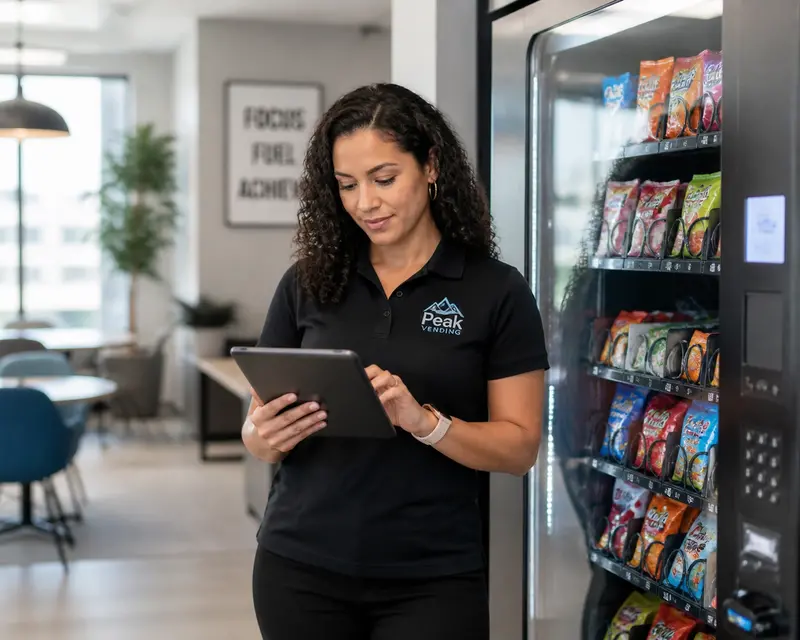
A professional vending operator using a digital tablet to calculate product margins in front of a modern glass-front vending machine.
The 2026 Pricing Formula
The Vending Club advocates for a standardized formula to remove the guesswork from your operations. This isn't about "what the guy down the street is charging": it is about what your business needs to survive.
The Base Price Formula:
Base Price = C ÷ (1 − GM%)
If your total unit cost is $0.85 and you want a 50% margin, the math looks like this: $0.85 ÷ (1 − 0.50) = $1.70.
However, a base price is just the starting point. To price each machine accurately, you must apply multipliers based on the specific environment of the machine:
- Location Factor (LF):
- Public/High-Sensitivity (Parks, Laundromats): 0.95–1.0
- Standard Workplace (Offices, Warehouses): 1.0–1.1
- Premium/Captive (Hotels, Airports, 24-Hour Hospitals): 1.1–1.3
- Demand Factor (DF):
- Elastic Items (Standard Chips, Water): 1.0
- Inelastic Items (Energy Drinks, Protein Bars): 1.05–1.15
After applying these multipliers, round to the nearest "clean" psychological price point: usually ending in .25, .50, .75, or .95.
🧮 Want to run your specific numbers? Use our Vending Profitability Calculator to model your route based on machine count, weekly sales, and costs.
Key-Value Items: The Anchor of Perception
You do not need to raise every price in the machine at once. In fact, doing so often triggers a "price shock" that can lead to location complaints. Instead, use the Key-Value Item (KVI) strategy used by major retailers.
Identify 5–10 products in your machine that are the most visible and price-sensitive: think bottled water, 12oz sodas, or standard 1oz chip bags. Keep the pricing on these KVIs relatively stable to anchor the customer's perception that the machine is "fair."
You then offset the lower margins on KVIs by aggressively pricing your premium selections. Vending Times reports that premium energy drinks and "better-for-you" snacks often command margins 15–20% higher than traditional carbonated soft drinks. By charging $3.50 or $4.00 for a high-performance energy drink, you protect the profitability of the entire machine even if the bottled water is still priced at $1.50.
Close up of a vending machine display showing a mix of standard snacks and high-margin premium protein bars with clear digital price tags.
Price Pack Architecture
In 2026, many manufacturers are practicing "shrinkflation": reducing the size of the product while keeping the price the same. As an operator, you can use Price Pack Architecture to your advantage.
Instead of trying to push a standard 2oz bag of chips to $2.25: a price point that often sees a significant drop in volume: consider switching to a smaller "vending size" pack that allows you to maintain a $1.75 or $2.00 price point. Alternatively, introduce "Value Tiers" within the machine:
- Good: Standard brands, smaller packs, high visibility, lower margin.
- Better: Name brands, standard sizes, average margin.
- Best: Premium/Organic brands, large sizes, high margin.
This gives the consumer a sense of choice and control. They aren't being "forced" into a high price: they are choosing a premium experience.
Leveraging The Vending Club Tools and Community
Building a scalable route requires more than just a few machines: it requires solid systems for tracking your costs, sales, and margins. At The Vending Club, we provide the tools to help you move from a "cash-and-carry" mindset to a professional operation run on real numbers.
You should regularly audit your pricing using our Vending Operator Tools. If you are looking to expand into new territories or need to justify price increases to a location manager, having data-backed reports from a recognized community like The Vending Club adds a layer of authority to your negotiations.
A group of vending professionals discussing business strategy and pricing charts during an industry networking event.
Implementing Dynamic and Seasonal Pricing
The technology available in 2026 allows for much more flexibility than the old manual price scrolls. If your machines are connected via modern telemetry, you can implement a "Light Dynamic" pricing model.
- Seasonal Resets: Increase the price of cold beverages by $0.25 in June and do the same for hot coffee or heavy soups in December.
- Time-of-Day Pricing: If your location is a secure, 24-hour facility like a hospital or distribution center, consider higher night-shift pricing for high-caffeine items.
- The "Nudge" Strategy: If a certain SKU isn't moving, do not just lower the price: move it to eye level (the "golden zone") and see if the volume increases at the current price before slashing your margin.
Strategic Communication: How to Raise Prices Without the Pushback
When a price hike is necessary, how you communicate it determines whether you keep the location or lose the contract. Avoid "blanket" increases across the whole machine: instead, phase them in alongside a "Freshness Guarantee" or a machine upgrade.
If a location manager questions the increase, point to the rising wholesale costs and the added value of your service: such as the cashless payment options, 24/7 reliability, and the curated product mix you provide through your The Vending Club membership. Most professional locations understand inflation: they are likely dealing with it in their own businesses. They just want to feel that they are still getting a professional, reliable service for the price they pay.
A clean, modern vending machine area in a corporate office with a "Freshness Guaranteed" sign and a contactless payment terminal.
Summary Checklist for 2026 Pricing
- Recalculate true unit costs including freight, fees, and commissions.
- Identify your 5–10 Key-Value Items (KVIs) to anchor price perception.
- Implement a Good/Better/Best tiering system for every machine.
- Use the Base Price Formula: C ÷ (1 − GM%).
- Audit your route every 6 months using the Vending Profitability Calculator.
- Transition away from "round" numbers that sacrifice margin: embrace the .75 and .95 endings.
Frequently Asked Questions
How often should I review my vending prices?
In the 2026 economy, a semi-annual review is the minimum. Top-tier operators perform a quarterly audit of their top 20% highest-selling SKUs to ensure wholesale spikes aren't eating their profits.
What is the "Golden Zone" in a vending machine?
The Golden Zone is the area at eye level (usually the second and third snack trays). This is where you should place your "Better" and "Best" tier items: those with the highest margins: because they receive the most visual attention.
Should I charge more for credit card transactions?
While some operators add a "convenience fee" for card use, the trend in 2026 is "frictionless pricing." It is generally better to set a single price that covers your fees rather than annoying the customer with an add-on charge at the point of sale.
What do I do if a location refuses a price increase?
Use your data. Show them the increase in wholesale costs. If they still refuse, you may need to evaluate the location's viability. A high-volume location with zero margin is often less valuable than a medium-volume location with healthy margins.
How do I find higher-margin products?
Stay active in the operator communities mapped in the Vending Community Guide. Operators frequently share which niche products: like local craft jerky or specialty energy drinks: are pulling in high margins in different regions.
Ready to stop guessing and start growing? Join The Vending Club as an Operator today and get access to the templates, tools, and networks you need to scale your business in 2026.